In oil and gas drilling and geological exploration operations, solids control systems are essentially the ‘logistics hub’ ensuring smooth operation. Their main task is to gradually separate solid particles from the drilling fluid, allowing for repeated use and maintaining stable performance. Many people, when mentioning solids control systems, immediately think of vibrating screens, desanders, and desilters, easily overlooking an equally important but later-positioned piece of equipment—the decarbonization centrifuge. In fact, the decarbonization centrifuge plays a crucial role in both ‘fine separation’ and ‘performance protection’ within the entire solids control system. If the front-end equipment removes ‘large impurities,’ then the decarbonization centrifuge handles those almost invisible fine solid phases that significantly impact drilling fluid performance. Especially under conditions of long-term circulating drilling fluid use, these fine solids, if not removed promptly, will gradually ‘drag down’ the entire system.
The Position and Division of Labor of Decarbonization Centrifuges in Solids Control Systems
In a complete solids control system, equipment typically separates solids in stages, from coarse to fine.
The general process is: vibrating screen → desander → desilter → centrifuge.
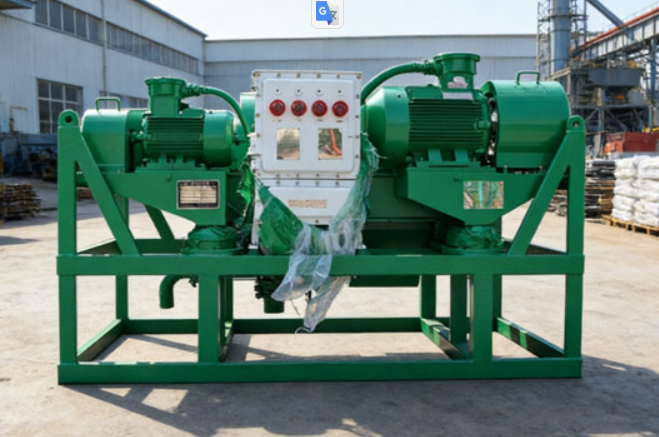
The decarbonization centrifuge is the final stage in this process. The preceding equipment mainly handles larger rock cuttings and sand particles, while the decarbonization centrifuge deals with finer solids with smaller particle sizes and a specific gravity closer to that of the drilling fluid itself. These tiny particles, if left untreated, may seem insignificant, but over time, they will make the drilling fluid increasingly thick and difficult to control. Therefore, the decarbonization centrifuge’s function can be understood as: specifically targeting these ‘invisible but deadly’ solids.
Reducing the Solids Content of Drilling Fluid
The most crucial and direct function of the decarbonization centrifuge is to reduce the content of low-density fine solid phases in the drilling fluid. These fine solid phases mainly come from: ultrafine rock cuttings formed by repeated drill bit crushing; impurities generated during the gradual aging of the drilling fluid during circulation; and foreign mud, sand, or formation fine powder. If not removed, these fine solid phases will accumulate, causing the drilling fluid to become increasingly contaminated. Decarbonization centrifuges effectively remove fine solids from the drilling fluid through centrifugal force generated by high-speed rotation, thus making the drilling fluid ‘clean’ again.
Stabilizing Drilling Fluid Performance
The performance of drilling fluids, such as viscosity, density, and rheology, is crucial for operational safety. Fine solid phases are the ‘hidden killers’ affecting these properties. When the content of fine solid phases increases: drilling fluid viscosity increases, pumping resistance increases; fluidity decreases, making incomplete downhole cleaning more likely; performance adjustment increasingly relies on additives, increasing costs. Decarbonization centrifuges, by continuously separating fine solid phases, can maintain drilling fluid performance within a relatively stable range, reducing the need for frequent adjustments and corrections. From this perspective, it is not just a ‘cleaning device,’ but more like a performance stabilizer.
Reducing Material Consumption
Many people only focus on the equipment price, ignoring the hidden costs during operation. In fact, decarbonization centrifuges make a significant contribution to cost control. When drilling fluid is contaminated with fine solid phases, common practices include: adding chemical treatment agents; diluting or replacing part of the drilling fluid. These operations all incur additional costs. Decarbonization centrifuges eliminate the source of the problem directly through physical means, significantly reducing reliance on chemical agents and lowering wastewater treatment volumes. In the long run, decarbonization centrifuges are often the kind of equipment that becomes more cost-effective with use.
Protecting Downstream Equipment and Downhole Conditions
Fine solids not only affect the drilling fluid itself but also have a cascading effect on equipment and the downhole environment. For example, they increase wear on pumps, valves, and pipelines; accelerate wear on drill bits and downhole tools; and increase the risk of stuck drill bits and differential pressure stuck drill bits. By reducing the amount of these fine solids, decarbonization centrifuges effectively ‘lighten’ the load on the entire system, allowing for smoother equipment operation and more controllable downhole conditions. This protective effect often only becomes truly apparent over long-term operation.
The role of decarbonization centrifuges in solids control systems goes far beyond simply adding another piece of equipment. Located at the back end of the solids control process, it specifically addresses the fine solid phases that are difficult for front-end equipment to handle. By reducing solids content, stabilizing drilling fluid performance, reducing material consumption, and protecting equipment and downhole conditions, it provides a solid guarantee for the entire drilling operation. Vibrating screens, desanders, and desilters solve ‘visible problems,’ while decarbonization centrifuges address ‘invisible but serious problems.’ It is this refined processing capability that allows the solids control system to truly form a complete, closed-loop management system.