
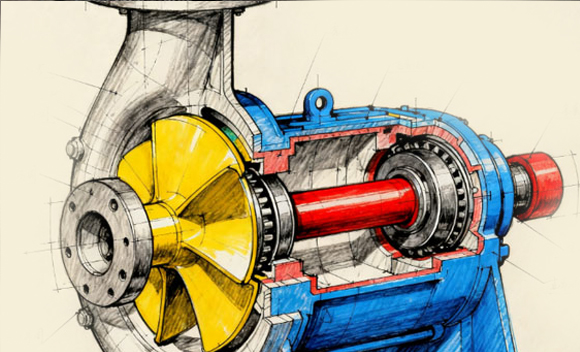
A centrifugal pump is a dynamic fluid transport device that uses the high-speed rotation of an impeller to throw liquid outwards and create a pressure difference. Its core working principle is quite straightforward—it relies on centrifugal force to ‘push’ the liquid outwards, continuously drawing fluid in through the pump inlet and out through the outlet. Due to its simple structure, stable operation, large flow rate, and strong adaptability, the centrifugal pump has become the most common and widely used pump type in industrial fluid transport, indispensable in fields ranging from chemical and pharmaceutical industries to water treatment, energy, and machining.

For everyday users, a centrifugal pump may simply be a device ‘responsible for transporting liquids’; however, from an engineering perspective, its efficiency, lifespan, and stability involve numerous technical details, including impeller design, materials for flow components, bearing systems, and sealing structure selection. Especially when handling corrosive, abrasive, solid-containing, or high-temperature media, the pump not only needs sufficient hydraulic performance but also requires a suitable sealing method to truly achieve ‘powerful, stable, leak-free, and durable transport.’
Centrifugal pumps are the most numerous and widely used pump type in all mechanical seal applications. Understanding centrifugal pumps is fundamental for customers to understand why mechanical seals are needed, why leaks occur, and why seals wear.
What is a centrifugal pump?
Why must the mechanical seal industry discuss centrifugal pumps?
In the entire fluid equipment system, centrifugal pumps are the ‘starting point’ for all seal design, fault analysis, and selection discussions. Over 70% of mechanical seals are installed on centrifugal pumps.
Whether customers discuss corrosion, particles, dry friction, leakage, or temperature, the working principle and operating characteristics of centrifugal pumps are inescapable.
For customers, understanding how centrifugal pumps work makes it easier to understand why seals fail; understanding the function of seals makes it easier to accept your professional advice and selection solutions.
Therefore, centrifugal pumps are the most fundamental concept that the mechanical seal industry should popularize.
Core Content (Industry-Specific)
① The Essence of Centrifugal Pumps: Transporting Liquids Through ‘Juggling’
From the perspective of the mechanical seal industry, the most important characteristic of a centrifugal pump is not its high flow rate, but rather:
* High-speed impeller rotation → High-speed rotation of the rotating ring along with the shaft → The sealing surface must withstand speed + pressure + temperature difference
This means that the load on mechanical seals is extremely high, and their lifespan depends on:
-Pump speed
-Medium pressure
-Medium temperature
-Lubrication condition
-Stable pump operation
The mechanical seal industry must emphasize:
Centrifugal pumps operate in extreme environments, making them one of the most demanding sealing scenarios among all rotating equipment.
② Why Must Centrifugal Pumps Use Mechanical Seals?
‘Why can’t ordinary rubber seals be used?’
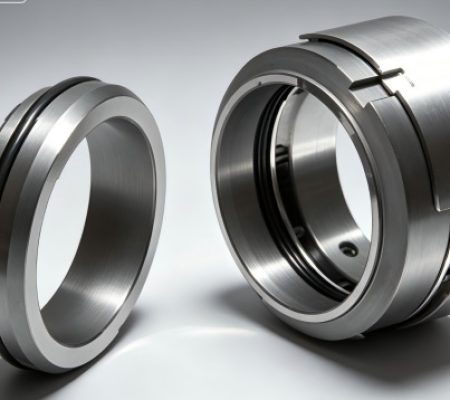
Because the centrifugal pump shaft rotates at high speed, a seal must be achieved through the contact of the rotating and stationary ring end faces. Only mechanical seals can withstand high-speed friction, pressure changes, and temperature shocks.
Ordinary sealing rings: only suitable for static or low-speed applications.
Mechanical seals: specifically designed for high-speed rotating surfaces.
③ The operating conditions of the centrifugal pump determine the selection of the mechanical seal
Temperature (higher temperatures lead to easier carbonization and thermal cracking of the seal)
Pressure (higher pressure results in greater load on the end face)
Media corrosivity (determines the material, such as silicon carbide, Hastelloy, fluororubber, EPDM)
Particle content (particles are the ‘ultimate killer’ of seals)
Speed (higher speeds accelerate wear)
④ Factors most likely to cause seal damage in centrifugal pumps
Common pump factors leading to mechanical seal damage include:
Pump cavitation
Excessive suction head/unstable inlet level
Dry running/idle operation
Excessive shaft vibration
Frequent start-stop cycles
Inlet blockage, low flow rate
Media particles eroding the end face
80% of mechanical seal failures are not due to the material, but rather to poor pump operating conditions.
⑤ Centrifugal pumps come in different types, each requiring a different mechanical seal structure.
Common centrifugal pumps requiring seals include
Chemical centrifugal pumps (IH, ZA) (Type)
Clean Water Pump
Instrument Pump
Multistage Pump (Boiler Pump)
Self-priming Pump
Oil Pump
Stainless Steel Sanitary Pump
Vertical Pump
Different Pump Sealing Types:
Single-end Face Seal
Double-end Face Seal
Balanced Seal
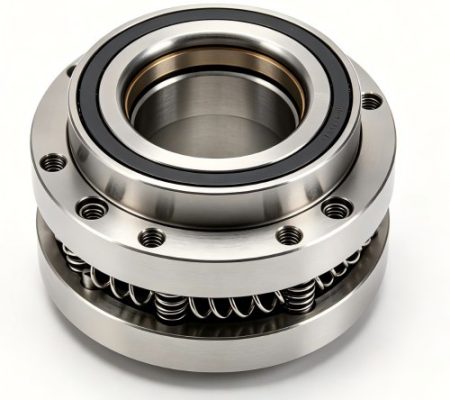
Cartridge Seal
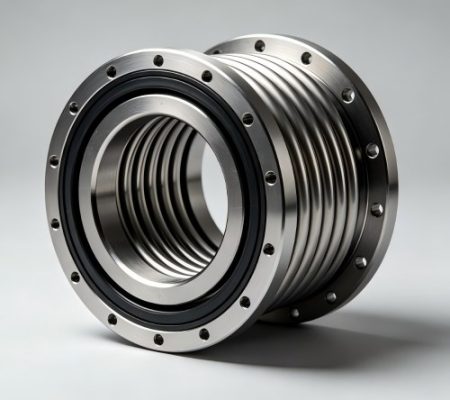
Metal Bellows Seal
Mechanical Seal + Flushing System
Centrifugal pumps are the core application scenario for all mechanical seals and also the main source of seal damage. On the surface, a centrifugal pump is just an ‘actuator’ in an industrial system, but in actual engineering practice, it plays a crucial role in ensuring the stable operation of the entire fluid system. Whether it’s highly corrosive media, solid particles, continuous heavy-load operation, or stringent sealing performance requirements, the design, selection, and configuration of centrifugal pumps directly determine a company’s production efficiency, safety level, and maintenance costs. Especially the application of mechanical seals in centrifugal pumps, which not only relates to whether the equipment leaks, but also to whether it can operate reliably for a long time under actual working conditions, avoiding frequent shutdowns or high seal replacement costs. Therefore, understanding, using, and matching centrifugal pumps has become an indispensable part of modern industry. A deep understanding of centrifugal pumps is essentially about ensuring the long-term stable operation of the entire fluid system. With proper selection, accurate sealing, and adequate operation and maintenance, centrifugal pumps can become a core component of a company’s reliable, durable, and cost-effective power equipment.