
Carbon ring seals are widely used in high-speed rotating equipment such as aero engines, gas turbines, compressors, and steam turbines due to their simple structure, high temperature resistance, corrosion resistance, and low coefficient of friction. Compared with mechanical seals, they do not rely on complex spring loading or require a liquid film to maintain the seal, thus exhibiting high reliability under extreme conditions. However, because their working principle differs fundamentally from that of mechanical seals, the carbon ring’s ability to adapt to shaft misalignment, vibration, thermal deformation, and axial movement is one of the most critical issues in engineering applications.
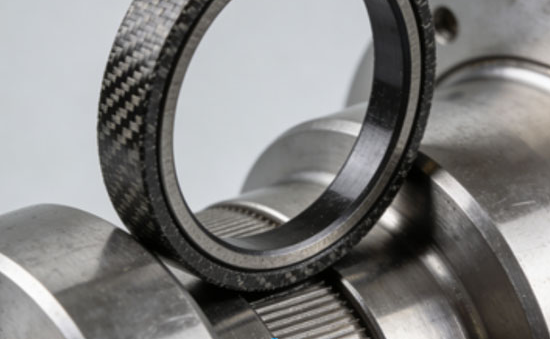
Axial movement is a significant factor affecting seal life. Whether due to equipment start-up and shutdown, load changes, thermal expansion, installation errors, or axial position changes caused by thrust bearing wear, all directly affect the sealing end face or sealing cavity structure. In carbon ring seals, the sealing characteristic between the carbon ring and the shaft sleeve is ‘contact + micro-leakage.’ While highly wear-resistant, it is also brittle and cannot rely on springs to compensate for axial displacement like a mechanical seal. Therefore, when axial displacement exceeds the structural tolerance limit, it can lead to severe wear, jamming, cracking, or even instantaneous failure.
Mechanism Determines Tolerance
Carbon ring seals employ a ‘floating working mode,’ where the carbon ring adheres to the bushing using its own weight, film force, or a small preload, and achieves sealing through multi-stage carbon rings and labyrinth throttling. This structure has strong self-adaptability to radial eccentricity, but its ability to compensate for axial displacement is limited. This is because: carbon rings are brittle materials and cannot withstand large end-face thrust; once movement causes the carbon ring to be squeezed by the shaft shoulder and cavity wall, stress concentration will occur, leading to fracture; the segmented interfaces between carbon rings (such as beveled cuts) are prone to misalignment and jamming under axial force. Therefore, the nature of carbon rings determines that they can withstand ‘slight, controllable, short-term’ axial movement, but cannot accept ‘continuous, large-scale, impact-type’ displacement.
Structure Determines Tolerance
The ability of a carbon ring to withstand axial movement is primarily influenced by the sealing structure:
Integral Carbon Ring
Advantages: Seamless, high concentricity, stable sealing efficiency.
Disadvantages: Completely lacks segmented buffering capability, with the lowest tolerance for axial movement.Typical allowable movement: 0.1–0.2 mm.
Segmented Carbon Ring
Each carbon ring consists of 2–4 segments, held closed by elastic buckles or metal bands.Segmentation can buffer axial movement to some extent, but it is not specifically designed to compensate for axial displacement.Typical allowable movement: 0.2–0.4 mm.
Multi-stage Carbon Ring Seals (e.g., in aircraft engines)
Pressure is distributed through multi-stage throttling, reducing the stress on a single stage.Axial displacement still needs to be strictly limited; otherwise, compression of one stage of the carbon ring will lead to chain failure.Typical allowable movement: Depends on the casing design, generally not exceeding 0.3 mm.Carbon ring seals generally can only withstand axial movement of 0.1–0.4 mm; exceeding this range significantly increases the risk of failure.
Risks Caused by Axial Movement
When carbon rings experience axial movement exceeding design limits, typical engineering failure phenomena occur, including:
End Face Crushing and Fracture: The carbon ring is pushed against the thrust face, resulting in brittle fracture.
Segmented Misalignment and Jamming: Misalignment of the beveled surfaces prevents the carbon ring from floating freely.
Seal Vibration and Wear: Axial movement causes changes in contact pressure, leading to overheating and wear.
Seal Gap Disturbance: This increases leakage and may even cause interstage pressure failure.
Carbon Powder Accumulation and Further Jamming: Wear powder enters the cut, causing secondary failure.According to engineering feedback, 80% of carbon ring failures are related to excessive axial movement or vibration.
How to Compensate in Design?
Although carbon rings are not suitable for withstanding large axial movements, their tolerance can be improved through design:Optimize Carbon Ring Material:Improve strength, toughness, and thermal shock stability.Adopt a Segmented Design:Give the carbon ring a certain degree of elastic resilience.Floating support structures should be implemented, such as metal support rings and elastic brackets.
Controlling the chamfer angle and interface clearance reduces the risk of misalignment and jamming.Improving lubrication and air film in the sealing cavity reduces frictional heat from the carbon ring.Limiting thrust bearing wear ensures that axial movement does not exceed design limits.Strictly controlling installation concentricity and end face position avoids human-induced axial movement deviations.These measures can significantly improve the carbon ring’s tolerance to axial movement, but cannot compensate indefinitely.
Whether a carbon ring seal can withstand axial movement essentially depends on its structural design, material properties, and application conditions. Compared to mechanical seals that rely on springs and compensation mechanisms, the compensation capacity of the carbon ring is inherently limited; therefore, its axial movement tolerance must be strictly controlled during the design phase. Any axial movement exceeding the limit can rapidly lead to failure through compression, misalignment, or jamming. In applications with high speeds, temperature differences, and large pressure gradients, the instantaneous impact caused by axial movement can not only damage the seal itself but also affect the operational safety of the entire equipment system.
The correct approach is not to rely on the carbon ring to ‘bear’ the axial movement, but rather to reduce axial movement through system design, buffer it through structural optimization, and prevent accidental axial movement through installation and maintenance. Only when factors such as shaft stability, cavity structure, material properties, and installation accuracy are controlled together can the carbon ring fully realize its advantages of low friction, high reliability, and long service life. In practical engineering, carbon ring seals are never isolated components, but rather a system composed of bearings, the machine body, and rotor dynamics.