Whether a carbon ring seal requires lubrication depends on its structure, working medium, cavity pressure, and equipment operation. Carbon ring seals are often considered ‘self-lubricating seals,’ but this doesn’t mean they require no lubrication at all. Rather, they rely on a combination of material self-lubrication, gas film/oil film lubrication, and operational lubrication to achieve low friction and stable lifespan. In many high-speed, high-temperature, gaseous media conditions, carbon rings primarily rely on micro-gas film lubrication; while in compressors, bearing housings, and other equipment, they may also be subject to oil-gas mixture lubrication. Carbon rings do not require additional artificial oil supply, but sufficient medium flow is needed to maintain operational lubrication.
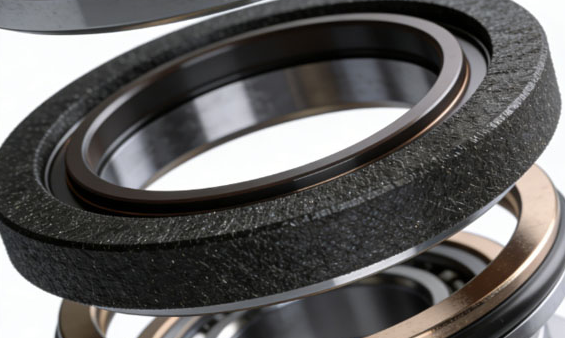
Material Self-Lubrication
Carbon graphite materials contain a layered structure, and their friction surfaces generate a natural lubrication effect, possessing the following characteristics: the layered lattice produces a low coefficient of friction; lubrication performance is maintained even at high temperatures; and the carbon film generated by friction continuously reduces friction. Therefore, carbon rings can operate without additional lubrication in most gas seals, a significant advantage over mechanical seals.
The Role of Film Lubrication in Carbon Ring Seals
In equipment such as aero engines, gas turbines, and steam turbines, carbon ring seals operate in high-speed rotating environments. High-speed rotation creates a micro-film (hydrodynamic lubrication) between the carbon ring and the bushing. Its functions include reducing contact pressure, minimizing wear and heat generation, and increasing seal life. Under certain operating conditions, it can achieve almost ‘non-contact operation.’ This aerodynamic lubrication is a key reason why carbon rings can remain stable at tens of thousands of revolutions per minute.
The Medium Itself Provides Lubrication
In applications such as compressors, gearboxes, and lubrication systems, carbon rings operate in an oil-air mixed environment. Lubrication in this case comes from: clean lubricating oil, oil-containing vapor, and oil mist carried from the bearing housing. These media can form a thin film at the carbon ring gap, significantly reducing wear. However, it is important to note that excessive oil can lead to increased leakage, carbon ring coking, and jamming. Therefore, engineering design emphasizes the control of the oil-air ratio.
Which Operating Conditions Are Sensitive?
The following operating conditions require adequate lubrication of the carbon ring; otherwise, rapid wear or ablation will occur:
Low-speed starts and frequent starts and stops: before an air film is established, pure mechanical contact friction may lead to premature wear or seizure.
High-temperature dry gas conditions: the medium is neither oil-free nor water-free, resulting in a rapid temperature rise and easy carbon powder accumulation. Sufficient airflow and cooling must be ensured.
Sealing cavities with high pressure differentials: high contact pressure requires medium flow to remove heat. Without lubrication, edge ablation will accelerate.
Carbon Ring Requirements
A common misconception in engineering practice is: ‘Carbon rings do not require lubrication, therefore completely dry operation is fine.’ The truth is: While carbon rings do not require external lubrication, this does not mean they can be used for long-term dry running in a zero-medium, zero-flow, and air film-free state.
Normal operation of carbon ring seals depends on: the self-lubricating properties of the carbon material, the micro-air film formed by medium flow, and oil-air mixture lubrication in the cavity (depending on the operating conditions). As long as the medium is stable, the carbon ring can achieve ‘quasi-non-contact’ operation, significantly extending its lifespan.
Engineering Diagnosis
The following operating phenomena often indicate insufficient lubrication and should be checked immediately: sudden increase in acceleration vibration; rapid rise in seal temperature; excessive carbon powder generation; sudden increase in leakage; carbon ring cut-off location; erosion; radial scratches on the bushing. If these problems are not addressed, they can lead to carbon ring breakage, seizure, or even damage to the bushing.
Carbon ring seals do not rely on external lubrication as in traditional mechanical seals. Instead, they utilize the material itself and the flow of the medium to achieve low-friction operation. Carbon ring seals do not require an additional supply of lubricating oil, but they do require sufficient medium flow and a stable gas film or oil-gas environment to maintain lubrication. With proper operating conditions, carbon rings can maintain extremely low wear even under extreme conditions; however, insufficient lubrication can cause even carbon materials to age or break rapidly, shortening their lifespan.