In oil and gas exploration and development, solids control equipment is core equipment for ensuring drilling fluid performance and improving drilling efficiency. For small drilling teams, configuring a solids control system that meets drilling needs and offers high cost-effectiveness within a limited budget is key to enhancing competitiveness.
Core Equipment Selection
Small drilling teams typically face realities such as shallow well depths, small drilling scales, and limited budgets. Therefore, equipment selection should prioritize practicality, efficiency, and durability, with a focus on modular, easy-to-maintain, and standardized equipment.
Vibrating Screen: A Cost-Effective First Line of Defense
The vibrating screen is the ‘gateway’ to the solids control system, undertaking more than 80% of the solids separation task. For small drilling teams, a double-layer linear vibrating screen is an option, offering the following advantages:
Processing Capacity:80-120 m³/h per unit, meeting the needs of shallow well drilling;
Separation Accuracy:The upper layer uses a 20-mesh screen (separating particle size ≥850μm), and the lower layer uses a 40-mesh screen (separating particle size ≥380μm), balancing coarse and fine particle separation;
Maintenance Costs:Modular design allows for screen replacement in just 10 minutes, resulting in low spare parts costs;
Economy:Domestic equipment costs approximately 50,000-80,000 RMB per unit, only one-third the price of imported equipment.
Desander + Desilter: The ‘Golden Combination’ of Centrifugal Separation
For fine particles (20-74μm) that the vibrating screen cannot handle, a desander and desilter are required. Small drilling teams can choose a combination of a 10-inch desander and an 8-inch desilter:
Processing capacity: A single desander can handle 20-30 m³/h, and a desilter 15-20 m³/h. Parallel connection can meet drilling needs up to 50 m³/h.
Separation accuracy: The desander can separate 40-74 μm particles, and the desilter can separate 15-40 μm particles.
Durability: The hydrocyclone cone uses polyurethane casting technology, increasing wear resistance by 3 times and extending service life to over 2 years.
Cost advantage: The price of a single set of domestically produced equipment is approximately 30,000-50,000 RMB, only half that of imported equipment.
Optimization suggestion: If the fine particle content in the drilling fluid is low, only a desander can be configured. By adjusting the bottom flow rate, desilting can also be achieved, further reducing costs.
Centrifuge: An ‘optional configuration’ for the fine treatment terminal
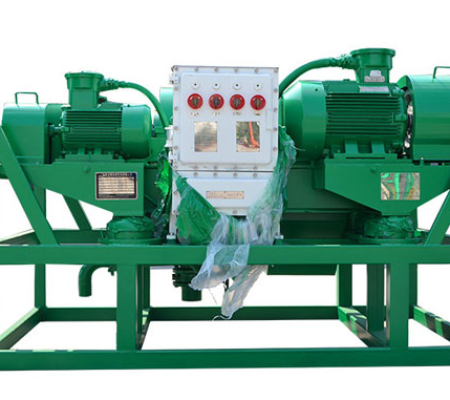
Centrifuges are used to separate ultrafine particles of 2-15 μm, but are more expensive (approximately 150,000-200,000 RMB per domestically produced unit). Small drilling teams can decide whether to configure a centrifuge based on the following conditions:
Drilling fluid type: If using water-based drilling fluid with high clay content, a centrifuge is required to control viscosity.
Drilling depth: Deep wells (>3000m) require a centrifuge to stabilize drilling fluid performance.
Environmental requirements: If it is necessary to recover base oil or barite from the drilling fluid, a centrifuge is essential.
Alternative solutions: If the budget is limited, the centrifuge can be temporarily deferred by increasing the capacity of the desilter or using chemical flocculants to reduce the content of ultrafine particles.
Process Optimization
Small drilling teams can achieve a ‘small but efficient’ configuration by optimizing the solids control process to reduce the number of equipment and energy consumption.
Three-Stage Purification Process: Vibrating Screen → Desander → Desilter
This process is suitable for most shallow well drilling scenarios. Its advantages include:
Simplified Process: Eliminates the need for centrifuges and vacuum degassers, reducing equipment investment and maintenance costs;
Increased Efficiency: By adjusting the underflow discharge of the desander and desilter, over 80% solid phase separation can be achieved;
Reduced Energy Consumption: Compared to a five-stage purification process, the three-stage process reduces energy consumption by 30%.
Integrated Design: Reduced Footprint and Pipeline Losses
Choosing integrated solids control equipment (such as an integrated design of vibrating screen and desander) achieves:
Reduced Footprint: Integrated equipment is 40% smaller than traditional equipment, suitable for drilling platforms with limited space;
Simplified Piping: Reduces overhead manifolds and bottom-connecting pipelines, lowering drilling pressure drop and energy consumption;
Convenient Installation: Modular design allows for equipment installation and commissioning within 2 hours.
Cost Control
Small drilling teams need to control costs throughout the entire chain of equipment procurement, use, and maintenance to maximize cost-effectiveness.
Procurement Strategy: Domestic Equipment + Bulk Purchase
Domestic Equipment: Domestic solids control equipment has performance approaching international standards, but its price is only 1/3 to 1/2 of imported equipment.
Bulk Purchase: Negotiate bulk purchase discounts with suppliers or jointly purchase with other drilling teams to reduce the cost per unit.
Used Equipment: If the budget is extremely limited, consider purchasing well-maintained used equipment, but strictly test its performance and lifespan.
Operation and Maintenance Management: Preventive Maintenance + Operation Training
Preventive Maintenance: Develop equipment maintenance plans and regularly replace vulnerable parts (such as screens and hydrocyclone cones) to avoid unplanned downtime.
Operation Training: Provide professional training to operators, standardize equipment usage procedures, and reduce equipment damage caused by improper operation.
Spare Parts Management: Establish a stock of commonly used spare parts (such as screens and seals) to ensure rapid repair in case of equipment failure.
The core principle for configuring solids control equipment for small drilling teams is ‘precisely matching drilling needs and avoiding over-configuration.’ By selecting modular, easy-to-maintain domestically produced equipment, optimizing solids control processes, and implementing full-chain cost control, an efficient and reliable solids control system can be built within a limited budget.