Metal bellows seals are a type of end-face sealing structure widely used in high-temperature, high-pressure, highly corrosive, or high-cleanliness environments. They rely on the elastic compensation capability of the metal bellows to replace traditional springs, achieving a stable fit between the dynamic and static rings. However, in actual operation and installation, metal bellows seals have several typical “vulnerable parts,” which can easily fail prematurely if improperly installed or selected.
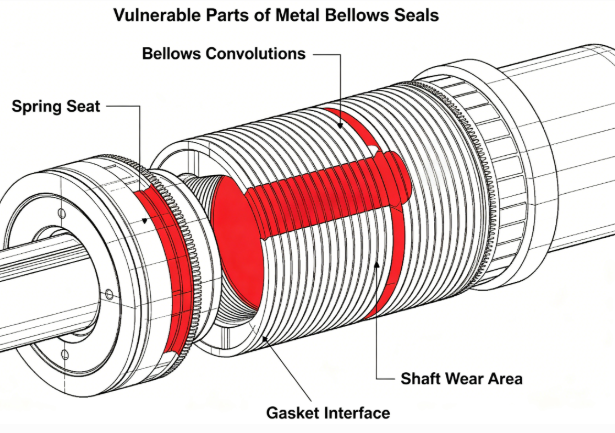
Where are the vulnerable parts of metal bellows seals?
The core structure of a metal bellows seal consists of a bellows assembly, dynamic ring, static ring, bushing, gland, and auxiliary sealing elements. The most critical and easily damaged parts are mainly concentrated in the bellows body, the weld transition zone, the contact surface between the dynamic and static rings, and the installation positioning area. The term “vulnerable parts” does not refer to design defects, but rather to the fact that these parts simultaneously bear multiple effects during operation, including pressure, temperature changes, axial compensation, and media corrosion. For example, the metal bellows body needs repeated compression and expansion to compensate for axial displacement; once the fatigue limit is exceeded, cracks or even fractures can easily occur. The dynamic and static ring end faces directly bear the friction and heat load, making them the highest-risk area for seal failure.
How does the installation process affect vulnerable parts?
Many vulnerability issues with metal bellows seals are not caused by operation, but rather by problems already present during the installation phase.
- Pre-installation Inspection and Pre-assembly
Before formal installation, it is necessary to check the bellows for transportation deformation, weld cracks, or signs of compression fatigue. Simultaneously, it is essential to confirm whether the surfaces of the dynamic and static rings are scratched or chipped. If these issues are neglected during pre-assembly, these defects will be rapidly amplified during later operation.
- Shaft and Sealing Cavity Cleaning
Before installation, the shaft sleeve, sealing cavity, and gland interior must be thoroughly cleaned. Any particulate impurities may become embedded in the sealing end face during operation, leading to localized wear. Especially for metal bellows structures, once particles become stuck, their free-compensation capability will be affected.
- Installation Positioning and Compression Control
Bellows seals are highly sensitive to compression. During installation, the axial preload must be strictly controlled. Excessive compression will cause the bellows to be under high stress for a long time, accelerating fatigue; insufficient compression will result in insufficient sealing pressure, leading to leakage.
- Coaxiality and Assembly Sequence Control
During installation, the coaxiality of the shaft and the sealing cavity must be ensured; otherwise, uneven wear of the rotating ring will occur. The assembly sequence cannot be arbitrarily adjusted, otherwise, torsional stress may be generated in the bellows.
- Trial Run and Hot-State Inspection
After installation, low-speed trial run and temperature rise tests must be performed to observe for leaks, abnormal vibrations, or excessively rapid temperature rise. Because the deformation behavior of metal bellows in the hot state differs from that in the cold state, it is necessary to verify its adaptability to actual working conditions.
Why are vulnerable parts prone to failure?
The failure of metal bellows seals essentially stems from the combined effects of “mechanical fatigue + thermal stress + media corrosion + installation errors.”
- Bellows Fatigue Fracture Problem
The bellows is a structure that achieves elastic compensation through repeated deformation of multiple layers of thin-walled metal. Under conditions of high-frequency vibration or frequent axial changes, each bellows undergoes tensile and compressive cycles. If stress concentration occurs or the material’s toughness is insufficient, cracks will form at the weld or bellows troughs, which are the most typical vulnerable points.
- Stress Concentration in the Weld Transition Zone
Bellows are typically welded, and the area connecting the bellows troughs and end rings is a typical stress concentration zone. During temperature cycling, microcracks easily form in this area, which can then expand into leakage channels.
- Thermal Cracking and Wear of the Moving and Static Ring End Faces
The moving and static rings are the parts that directly contact the medium and also bear frictional heat. Insufficient cooling or poor lubrication can lead to excessive local temperature rise, causing thermal cracking, burning, or even surface peeling.
- Local Overload Due to Installation Eccentricity
If the shaft and the sealing cavity are not coaxial, the moving ring will generate periodic eccentric loads during rotation, causing excessive stress on one side of the bellows for a long time, thus leading to premature fatigue failure.
- Media Corrosion Accelerates Structural Failure
In corrosive media, improper material selection can lead to intergranular corrosion or pitting in the bellows and weld areas, resulting in decreased structural strength and further amplifying fatigue risks.
Do Different Materials Determine Vulnerability?
Material selection is one of the core factors affecting the seal life of metal bellows. Different materials directly determine their fatigue resistance, corrosion resistance, and high-temperature resistance.
- Bellows Body Material Selection
Common materials include 316L stainless steel, Hastelloy, and Inconel alloys. 316L is suitable for general corrosive environments, but it is prone to fatigue under high-temperature or strong corrosive conditions; Hastelloy and nickel-based alloys have higher corrosion resistance and fatigue resistance, making them suitable for harsh operating conditions.
- Matching Welding Materials and Processes
Welding materials must match the bellows base material; otherwise, weak points will form in the weld area. High-quality seals typically use laser welding or electron beam welding to reduce the heat-affected zone and improve structural uniformity.
- Selection of Materials for Dynamic and Static Rings
Common materials for dynamic and static rings include silicon carbide, tungsten carbide, and graphite. Silicon carbide is suitable for high-temperature and high-corrosion conditions and has strong wear resistance; tungsten carbide has better impact resistance; graphite is suitable for media with good lubrication conditions.
- Auxiliary Sealing Materials
O-rings or auxiliary seals are usually made of fluororubber, perfluororubber, or PTFE. Different materials are suitable for different temperature and chemical environments; incorrect selection can lead to premature aging or swelling.
Why are metal bellows seals more prone to “fatigue failure” than ordinary mechanical seals?
Metal bellows seals are structures that rely on the elastic deformation of metal. Unlike traditional mechanical seals that rely on independent springs for compensation, they allow the bellows body to continuously participate in elastic movement. This means that it is always in a “working deformation state” during operation, rather than a static support state. As long as the equipment is running, it is constantly expanding and contracting. Because of this, its failure mode is more often “cumulative fatigue” than sudden failure. If the compression during installation is unreasonable, there is shaft eccentricity, or the medium temperature fluctuates greatly, the metal fatigue process of the bellows will be accelerated. Furthermore, the weld area and trough locations are stress concentration points, making them prone to microcrack propagation under prolonged stress cycles. Therefore, it’s not that it’s “more fragile,” but rather that its operation is “more dependent on precise matching,” requiring higher installation accuracy and stricter operating condition control.
Metal bellows seals may seem like a small component in compressors or pumps, but their structure is actually very precise, and their operation differs from ordinary seals. They don’t rely on simple springs for support; instead, they depend on the continuous expansion and contraction of the metal bellows itself to compensate for shaft movement. Because of this operating method, its “vulnerability points” are mainly concentrated in the bellows body, welded areas, and the end faces of the moving and stationary rings. These parts are subjected to long-term pressure, temperature changes, and mechanical deformation. Slightly improper installation—such as incorrect compression, misalignment of the shaft, or incorrect material selection—can gradually accumulate damage during operation, eventually leading to leakage or failure. Many field problems are not due to poor product quality, but rather to mismatched installation conditions and operating conditions. As long as cleaning, alignment, and compression control are performed before installation, and appropriate materials are selected according to the actual medium, while ensuring stable operating parameters, the metal bellows seal is actually a very reliable structure.