In oil and gas drilling operations, the rationality of well site equipment layout directly affects operational efficiency, safety levels, and cost control. Traditional well sites often suffer from problems such as time-consuming equipment handling, limited personnel operating space, and frequent safety hazards due to haphazard equipment placement and chaotic logistics paths. Statistics show that optimizing well site equipment layout can shorten drilling cycles by 10%-15% while reducing the risk of unplanned downtime. This article will systematically explore the core strategies for optimizing well site equipment layout from four dimensions: spatial planning, process coordination, safety standards, and dynamic adjustments, providing practical guidance for enterprises to create an efficient and safe operating environment.
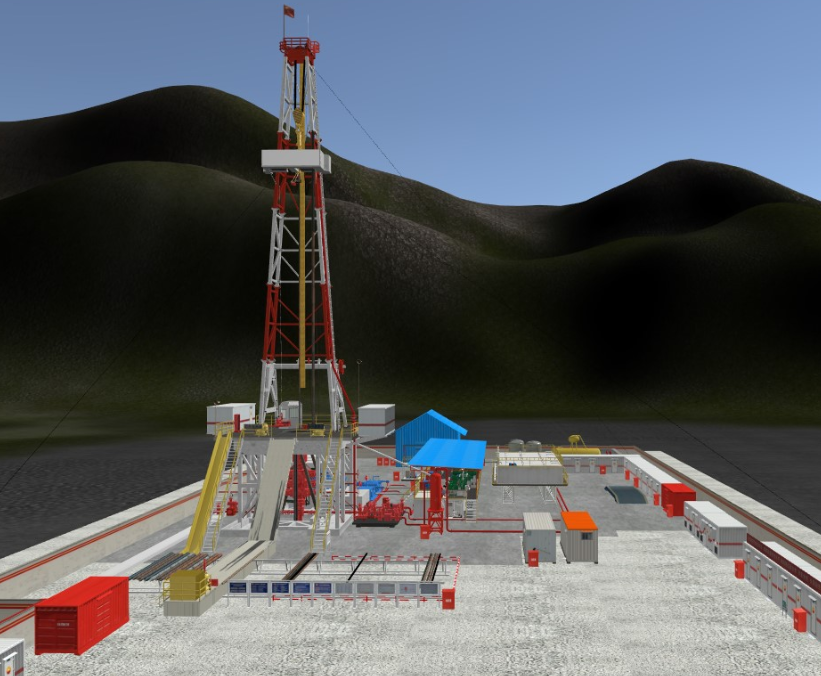
Spatial Planning: Achieving Compact Equipment Layout Based on Functional Zoning
Well site spatial planning should follow the principle of “centralized functions and smooth processes,” dividing equipment into five modules according to operational stages: drilling rig area, mud circulation area, power area, material storage area, and emergency area. For example, the drilling rig area, as the core operating area, needs to be close to the wellhead center to reduce the transportation distance of drill pipes and drilling tools; the mud circulation area (including mud pumps, vibrating screens, centrifuges, etc.) should be adjacent to the drilling rig area to ensure the shortest mud delivery pipeline and reduce pressure loss; the power area (diesel generator sets, distribution cabinets) needs to be located upwind of the well site to avoid exhaust gas pollution of the operating area, while reserving maintenance access for the hoisting of large equipment (such as engines). The material storage area needs to store consumables such as drill bits, drill pipes, and casing in a categorized manner, and use automated shelving or containerized storage to improve space utilization. Through modular layout, an oilfield reduced its well site area from 3000㎡ to 2200㎡, and equipment transportation time by 40%.
Process Collaboration: Streamlining Operational Links to Reduce Ineffective Waiting and Repetitive Operations
Well site operations involve multiple stages such as drilling, tripping in and out of the well, mud treatment, and cementing. Equipment layout must aim for “shortest process and minimal interference.” For example, during drilling, the drilling rig, top drive, and mud pump need to form a “triangular working area” to ensure synchronized drill pipe connection/disconnection and mud circulation, avoiding drilling interruptions due to excessive equipment distance. During tripping in and out of the well, the drill pipe rack, catwalk, and tubing loader need to be arranged in a straight line along the wellhead, ensuring a straight path for the drill pipe from the wellhead to the storage area, reducing manual handling or forklift transfers. Furthermore, the equipment operation sequence needs to be optimized, such as placing the mud material inlet between the vibrating screen and the centrifuge, allowing the material to directly enter the circulation system and avoiding secondary handling. One drilling company, through process optimization, reduced the single trip trip time from 2.5 hours to 1.8 hours, increasing daily drilling footage by 20%.
Safety Regulations: Reserve Safe Distances to Build a Risk Prevention Barrier
The layout of equipment at the well site must strictly adhere to safety regulations, with a focus on preventing risks such as fire, explosion, and mechanical injury. For example, high-pressure equipment (such as high-pressure manifolds and blowout preventers) must maintain a safe distance of at least 15 meters from flammable materials (such as diesel tanks and chemical materials); fire-resistant isolation zones must be set up between the drilling rig derrick and the power area to prevent the spread of fire caused by electrical faults; personnel operating areas (such as the driller’s room and duty room) must be far away from vibration sources (such as mud pumps and vibrating screens) to reduce the impact of noise and vibration on the human body. In addition, emergency escape routes must be planned, ensuring that the routes are at least 1.2 meters wide and unobstructed by equipment, facilitating rapid evacuation of personnel. In one oilfield, insufficient distance between the high-pressure manifold and the diesel tank (only 8 meters) led to a manifold leak and a fire, resulting in direct losses exceeding ten million yuan. The hazard was completely eliminated by adjusting the layout.
Dynamic Adjustment: Adapting to Changing Operating Conditions and Achieving Flexible Layout Upgrades
Well site operating conditions are complex and variable (such as deep wells, ultra-deep wells, and horizontal wells), requiring equipment layouts to have dynamic adjustment capabilities. For example, in deep well operations, the number of mud storage tanks needs to be increased, and solids control equipment such as centrifuges and desanders need to be placed closer to the wellhead to handle the high-density mud. In horizontal well operations, specialized tools such as rotary steerable drill strings and measurement-while-drilling (MWD) equipment need to be positioned near the drilling rig’s control panel for easy real-time monitoring and adjustment. Furthermore, modular equipment (such as portable mud pumps and containerized power stations) can be used to quickly reconfigure the layout according to operational needs, reducing equipment assembly and disassembly time. One drilling platform successfully transitioned from conventional wells to ultra-deep wells by dynamically adjusting its layout, reducing single-well costs by 18%.
Optimizing well site equipment layout is a key aspect of improving drilling efficiency and reducing safety risks. Enterprises need to work collaboratively in four areas: spatial planning, process coordination, safety standards, and dynamic adjustments to build a “compact, efficient, safe, and flexible” operating environment. In the future, with the application of technologies such as digital twins and AI algorithms, well site layout will evolve towards “intelligent planning” and “autonomous optimization.” By simulating equipment operating status in real time and predicting operational needs, the optimal layout scheme will be automatically generated, providing stronger efficiency support for oil and gas exploration and development.