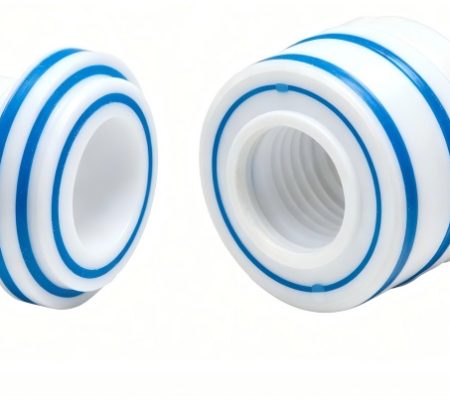
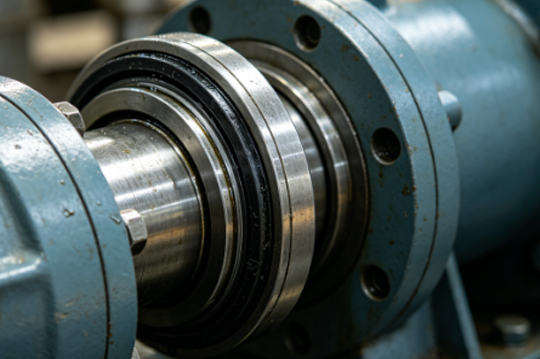
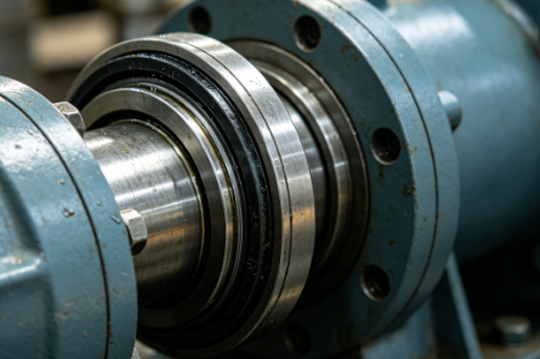
Mechanical seals in chemical pumps are critical dynamic sealing devices used to prevent media leakage between the pump shaft and casing. They are widely used in industries such as petroleum, chemical, and pharmaceutical. Their core structure typically consists of a dynamic ring, a stationary ring, a spring assembly, and auxiliary sealing rings. A very thin liquid film is formed through the precise fit of the sealing surfaces at both ends, achieving a working state of “allowing rotation but not leakage.” Leakage in a mechanical seal does not necessarily mean “complete failure,” but rather the disruption or loss of control of the liquid film between the sealing surfaces. When the end faces are worn, deformed, experience dry friction, or have insufficient lubrication, the media will leak axially or radially. In chemical environments, because the media are often corrosive, high-temperature, or contain particles, the risk of leakage is further amplified once the mechanical seal becomes unstable.
Standard Process Control for Mechanical Seal Installation and Operation
In the operation of chemical pumps, the condition control of the mechanical seal is integrated throughout the four stages of “installation—commissioning—operation—maintenance,” each stage directly affecting the final seal life and leakage probability.
· Pre-installation Inspection and Preparation Stage
Before installing the mechanical seal, a comprehensive inspection of the pump shaft runout, shaft sleeve wear, and sealing cavity dimensions is required. Excessive axial or radial runout will directly lead to uneven stress on the sealing end face, resulting in abnormal wear in the initial stages of operation. Furthermore, it is necessary to confirm the seal type and media compatibility, such as whether the corrosion-resistant material is suitable for the current chemical medium; otherwise, subsequent adjustments will be extremely costly.
· Installation and Alignment Stage
During installation, it is essential to ensure that the contact surfaces of the dynamic and static rings are clean and free of particulate contamination. Simultaneously, the compression amount must be strictly controlled to avoid over-tightening leading to end face overheating or over-loosening causing leakage. The coaxiality of the pump and motor must be controlled within the allowable range; otherwise, periodic uneven loading will occur during high-speed operation, causing uneven wear on the sealing end face.
· Trial Operation Stage
During trial operation, it is crucial to observe the sealing cavity temperature and pressure fluctuations, as well as whether the flushing system is functioning properly. Interruption or insufficient flow of the flushing fluid will cause short-term dry friction on the end face, which is one of the main causes of early failure. Simultaneously, prolonged idling should be avoided, as the mechanical seal is highly susceptible to burnout without media lubrication. (4) Normal Operation and Maintenance Phase During operation, a regular inspection mechanism should be established to monitor the leakage trend, rather than only addressing it after it occurs. Simultaneously, anti-clogging maintenance should be performed on the flushing pipeline to prevent particle deposition from affecting cooling efficiency, thereby reducing the risk of thermal deformation.
The Core Causes and Prevention of Mechanical Seal Leaks
· End Face Wear and Thermal Deformation
The core friction pair of the mechanical seal is in a state of high-speed relative motion for a long time. If the lubrication film is unstable, dry friction will occur, leading to a sharp increase in end face temperature, which in turn causes thermal cracks or deformation. Preventive measures include optimizing the flushing scheme, improving cooling efficiency, and selecting high-temperature resistant materials (such as silicon carbide, hard alloys, etc.) to enhance thermal shock resistance.
· Influence of Media Particles and Corrosion
In media containing particles or highly corrosive substances, the sealing end face is easily cut by abrasive particles or chemically corroded, forming micro-cracks and gradually expanding the leakage channel. To address this problem, a double-end face sealing structure or a filtration and flushing system can be used to reduce particles entering the sealing cavity from the source.
· Shaft Vibration and Alignment Error
Excessive pump shaft vibration can cause periodic separation and impact contact of the sealing end face, resulting in irregular wear. Simultaneously, excessive installation alignment deviation can cause uneven stress on the seal, creating localized high-pressure zones and accelerating seal failure. Therefore, the error range must be controlled using a laser alignment instrument or precision calibration methods.
· Fluctuations in Operating Conditions
Severe fluctuations in pressure or temperature can cause instantaneous instability of the sealing structure. For example, a sudden drop in temperature of a high-temperature medium may cause thermal shrinkage cracks. Therefore, stable operating conditions should be maintained as much as possible during the process design phase, and frequent start-ups and shutdowns of the equipment should be avoided.
Common Questions
Q: Does a slight leak in a mechanical seal necessarily require immediate replacement?
Not necessarily. A slight leak is normal lubricant release under certain operating conditions. However, if the leakage continues to increase or is accompanied by abnormal temperature rise, it indicates that the sealing surface has entered the failure stage and should be repaired as soon as possible.
Q: Why is there such a large difference in the lifespan of mechanical seals?
It mainly depends on the matching degree of operating conditions, installation quality, and the stability of the flushing system. The lifespan of the same model of seal can differ by several times under different operating conditions.
Q: Can the leakage problem be completely solved by upgrading the material grade?
No. Material is only one of the influencing factors. If the system vibration, alignment, or flushing design is inadequate, leakage will still occur even with high-end materials.
The leakage problem of mechanical seals in chemical pumps is not essentially a problem of a single component, but rather the result of the combined effects of equipment, operating conditions, and operation. From installation accuracy to the operating environment and maintenance methods, every aspect affects the final sealing effect. Many field problems are not due to “poor seal quality,” but rather to system imbalance caused by insufficient flushing, excessive shaft vibration, or changes in media conditions. To reduce leakage, it’s not about replacing after the fact, but about controlling risks in advance, including correct selection, standardized installation, stable operation, and continuous monitoring. As long as the equipment conditions are properly matched, mechanical seals can actually operate stably for a long time without frequent replacement.