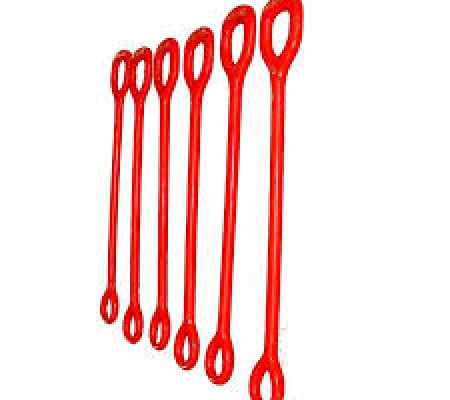
In oil and gas well operations, equipment installation, and heavy lifting tasks, the Elevator Link, as a critical wellhead tool and load-bearing connection component, plays a vital role in operational safety. Its service life directly affects lifting reliability and personnel safety. Once an Elevator Link fails due to fatigue or structural damage, the consequences can be severe. Therefore, accurately evaluating its service life and adopting effective extension strategies are essential parts of safe field operations.
Why Elevator Link Service Life Evaluation Is Essential
During long-term use, Elevator Links are subjected to repeated tensile loads, impact forces, and harsh environmental conditions. Even if no visible damage is present, internal material fatigue may already exist. Relying solely on visual appearance or usage time to judge whether an Elevator Link can continue to be used involves significant risk.
A systematic service life evaluation helps to:
Identify potential safety hazards early
Prevent overload or overuse beyond design limits
Provide a scientific basis for maintenance and replacement decisions
For high-risk lifting operations, service life evaluation is an integral part of safety management.
Key Factors in Elevator Link Service Life Evaluation
1.Actual Operating Conditions
The service life of an Elevator Link is not fixed and is highly dependent on real operating conditions, including:
Whether the applied load approaches or exceeds the rated capacity
Frequency of impact loads or dynamic lifting
Exposure to corrosive environments, high temperatures, or moisture
The harsher the operating conditions, the shorter the effective service life is likely to be.
2.Visual Inspection and Dimensional Changes
Routine visual and dimensional inspections are the most basic and practical evaluation methods. Special attention should be paid to:
Surface cracks or permanent deformation
Wear or damage to threaded areas
Noticeable reduction in cross-sectional thickness
Any abnormal findings should lead to immediate suspension of use and further inspection.
3.Material Fatigue and Internal Damage Assessment
For Elevator Links used over long periods or in critical positions, non-destructive testing methods such as magnetic particle testing or ultrasonic inspection can be applied to assess internal fatigue or hidden cracks. These techniques provide reliable data for determining whether continued use is safe.
Common Factors That Reduce Elevator Link Service Life
In practical operations, several factors frequently accelerate deterioration and failure:
Long-term operation near or beyond rated load limits
Improper installation leading to uneven stress distribution
Damage to surface coatings, causing corrosion
Lack of regular inspection schedules and maintenance records
These issues typically develop gradually and may go unnoticed without proper management.
Effective Strategies to Extend Elevator Link Service Life
Strict Load Control
During selection and operation, the rated load of the Elevator Link should exceed actual working requirements, with sufficient safety margins. Avoid prolonged use under near-maximum load conditions to reduce fatigue accumulation.
Proper Installation and Correct Usage
The Elevator Link should be installed with correct alignment to ensure axial loading. Side loading, angled lifting, or sudden impact lifting should be avoided. Threaded connections must be fully engaged to prevent localized stress concentration.
Regular Inspection and Periodic Testing
Establish a routine inspection system. Perform quick checks before each operation and comprehensive inspections at fixed intervals. Maintaining detailed inspection records provides valuable data for service life evaluation and decision-making.
Corrosion Protection and Proper Storage
After operations, Elevator Links should be cleaned to remove oil, debris, and corrosive substances. For long-term storage, apply anti-corrosion oil and keep them in dry, well-ventilated environments. Avoid random stacking or outdoor exposure.
When Should an Elevator Link Be Retired?
An Elevator Link should be immediately removed from service if any of the following conditions are observed, regardless of its theoretical service life:
Visible cracks or permanent deformation
Internal defects detected through non-destructive testing
Unclear usage history or unknown load records
Safety must always take priority over cost considerations.
Conclusion: Scientific Evaluation Is the Key to Long-Term Safety
The service life of an Elevator Link should never be judged by time alone. It must be evaluated based on operating conditions, inspection results, and maintenance practices. By implementing scientific evaluation methods and standardized usage and maintenance strategies, operators can significantly extend the service life of Elevator Links while ensuring safe and reliable wellhead and lifting operations.