In many industrial equipment, sealing is a crucial element ensuring safe operation. While you may have heard of mechanical seals, the term ‘external mechanical seal’ might be unfamiliar. An external mechanical seal is a sealing device installed outside the shaft of a pump or rotating equipment, using external components to isolate and seal the medium. Compared to internal mechanical seals, its installation location outside the equipment makes inspection and maintenance easier. Especially when handling high-temperature, high-pressure, and corrosive media, external mechanical seals play a unique role in protecting the safe operation of the equipment.
Basic Structure of an External Mechanical Seal
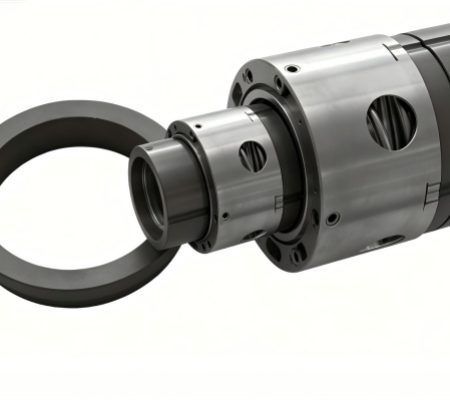
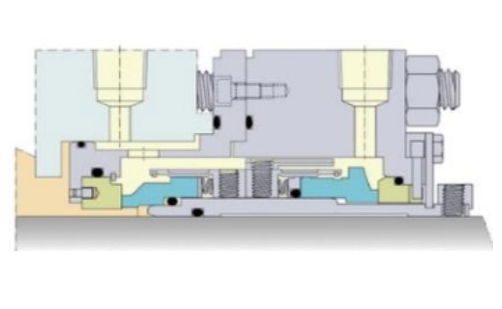
An external mechanical seal mainly consists of a rotating ring, a stationary ring, a spring, and an external sealing bracket. Unlike internal seals, the key components of an external seal are not directly installed inside the pump body but are fixed to the outside of the equipment by a bracket. The rotating ring is attached to the rotating shaft, and the stationary ring is fixed to the bracket. The spring maintains the contact pressure between the two to form a sealing surface. Meanwhile, external mechanical seals are typically equipped with auxiliary seals and cooling devices to ensure good sealing performance even under high-temperature or high-speed operating conditions.
Working Principle of External Mechanical Seals
The core principle of external mechanical seals is also ‘face sealing.’ When the equipment is running, the rotating ring rotates with the shaft, while the stationary ring remains fixed, and the two fit closely together to form a sealing surface that prevents media leakage. Springs and supports ensure uniform pressure on the sealing surface, preventing leakage even when the equipment is subjected to vibration or thermal expansion and contraction. Because the sealing components are located outside the equipment, liquids or gases can be cooled or lubricated through auxiliary pipelines, thereby reducing wear on the sealing surface and increasing service life. This external structural design makes external mechanical seals easier to manage and maintain under certain special operating conditions.
Advantages of Externally Mounted Mechanical Seals
Externally mounted mechanical seals offer several significant advantages: installation without disassembling the pump body or internal components, reducing downtime; faster inspection, adjustment, and replacement of seals due to their external installation; flexible configuration of external cooling and lubrication systems, suitable for high-temperature, high-pressure, or highly corrosive media; and reduced additional wear on bearings and shafts through pressure adjustment via external supports and springs. These features make externally mounted mechanical seals widely used in industries such as chemical, petroleum, power, and food processing, especially suitable for large pumps and chemical reactors.
Precautions for Using Externally Mounted Mechanical Seals
Although externally mounted mechanical seals are easy to install and maintain, the following precautions should still be taken during use: The clearance between the sealing surfaces must be precise to ensure sealing effectiveness and service life; appropriate coolant or lubricant should be used according to operating conditions to prevent overheating of the sealing surfaces; suitable sealing materials and springs should be selected based on the temperature, corrosiveness, and pressure of the medium; even with convenient maintenance, the condition of the sealing surfaces and supports should be checked regularly to prevent blockage or corrosion. These details are crucial for extending the life of externally mounted mechanical seals and ensuring safe equipment operation.
An external mechanical seal is a mechanical seal device in which the sealing components are installed outside the equipment. It uses a rotating ring, a stationary ring, and a spring to form a sealing surface, effectively isolating liquids or gases. Compared to internal seals, it is easier to install and maintain, and is particularly suitable for high-temperature, high-pressure, and corrosive environments. The cooling and lubrication systems of external seals can be flexibly configured to ensure long-term stable operation of the sealing surface.