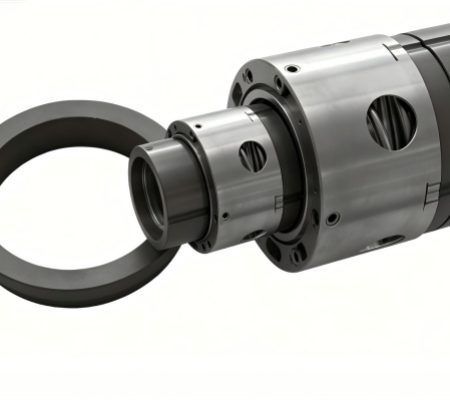

An integrated centering device is used in drilling and cementing operations to control the position of the casing in the wellbore, keeping it centered and thus improving the distribution of cement slurry in the annulus. The downhole environment is complex, and the casing is prone to eccentricity or displacement, affecting cementing quality and sealing performance. This tool optimizes spatial distribution through mechanical support, making the construction process more stable and controllable.

Maintaining Casing Centering to Improve Cementing Quality
Whether the casing is centered directly affects the quality of cement sheath formation. Eccentricity can lead to locally thin cement layers, creating weak sealing zones. The integrated centering device, through its elastic support structure, stabilizes the casing in the central area of the wellbore, allowing cement slurry to be evenly distributed around the outer wall of the casing, thereby improving overall cementing integrity.
- Casing centering reduces cement flow deviation.
- Cement sheath thickness distribution is more uniform.
- Reduces the risk of localized sealing failure.
- Improves the bonding strength between the formation and the casing.
- Improves long-term sealing stability.
The more stable the centering effect, the more reliable the cementing quality.
Improving Annular Fluid Flow
The annular fluid plays a role in replacement and cleaning during cementing. If the flow path is uneven, stagnant areas will form, affecting drilling fluid replacement efficiency. The centering device can optimize the annular gap structure, making fluid flow smoother, reducing dead zones, and improving replacement effect.
- Uniform annular gap reduces flow resistance.
- Improves drilling fluid and cement slurry replacement efficiency.
- Reduces localized fluid stagnation areas.
- Improves flushing effect and enhances wellbore cleaning.
Improves overall cementing construction efficiency. After optimizing the fluid state, cementing quality is easier to control.
Improved Wellbore Cleaning and Construction Efficiency
The cleanliness of the wellbore directly impacts cementing effectiveness. Excessive mud cake or drill cuttings residue can affect cement bond strength. The centering device stabilizes the casing position, ensuring more uniform fluid flushing and improving wellbore cleaning capabilities, thereby enhancing overall construction quality.
Enhanced Casing Stability and Anti-Displacement Capability
Downhole casing is prone to displacement under gravity, wellbore contact, and fluid action. The centering device reduces eccentricity through structural support, keeping the casing in a more stable position. A stable structure reduces local friction and stress concentration, minimizing uneven stress during operation and improving overall operational reliability.
Adaptability to Complex Well Conditions and Enhanced Operational Reliability
In highly deviated wells, horizontal wells, and irregular wellbore environments, casing displacement is more likely, placing higher demands on the centering device. The integrated structure offers strong adaptability, providing stable support under various well conditions, making the cementing process more controllable and improving overall operational reliability and safety.