In the mechanical seal industry, many engineers have come to deeply understand that equipment stability often depends not on the sealing structure itself, but on the actual durability of the end face. As pumps transport increasingly complex media, containing more solid particles, higher corrosiveness, greater pressure fluctuations, higher speeds, or more frequent start-stop cycles, the thermal load, wear intensity, and corrosion rate on the end face are amplified exponentially. If traditional materials are still used, the seal life cannot meet the requirements of modern factories for continuous production and low maintenance costs.
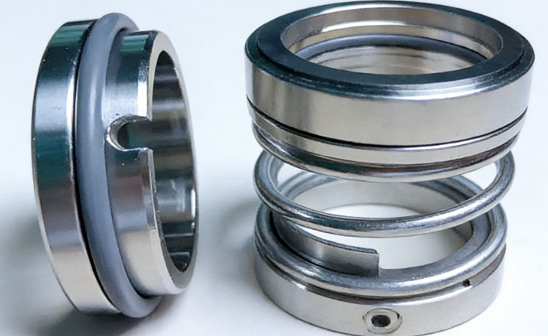
In this context, material coatings have become one of the key technologies for improving seal life. Coatings are not simply about making the seal ‘harder’ or ‘smoother,’ but rather about systematically improving sealing performance by altering the physical properties, frictional characteristics, and chemical stability of the end face surface. They reduce end face wear, lower heat generation, resist corrosion, and maintain a more stable liquid film operation, extending the reliability window of the seal even under less than ideal operating conditions.
Improving End-Face Wear Resistance
Coatings significantly enhance the wear resistance of end faces, making them more resistant to abrasive damage in environments containing solids, abrasives, or microparticles. Common coatings such as carbide and diamond-like carbon (DLC) coatings can substantially increase surface hardness, thereby reducing scratches, pitting, or surface damage.
Several key performance aspects benefit from improved end-face wear resistance:
Maintaining end-face flatness and delaying geometric failure
Reducing particle ingress into the sealing interface
Extending liquid film retention time
Significantly extending the service life of seals in harsh media
For pumps conveying silt, crystals, light solid particles, or operating conditions with large fluctuations, wear-resistant coatings can effectively reduce premature leakage caused by sudden wear.
Reducing Frictional Heat Generation Rate
Reducing the end-face friction coefficient is one of the most crucial performance characteristics of coatings. A lower friction coefficient means less frictional heat, less thermal deformation, and a more stable end-face condition. This directly improves the reliability of the seal under high-speed, high-pressure, and frequent start-stop conditions.
The coating’s friction-reducing capabilities offer several engineering advantages:
Lower end-face temperature, reducing thermal shock and localized blueing
Reduced risk of dry friction, making it less prone to burnout even with short-term fluid shortages
Significantly extended lifespan for high-pressure pumps, hot oil pumps, and condensate pumps
Improved start-stop stability, reducing ‘adhesive slip’ phenomena
For systems sensitive to temperature rise, experiencing frequent thermal shocks, or under high heat loads, the coating provides quantifiable lifespan improvements.
Enhanced Chemical Media Protection
Many premature seal failures are not due to wear, but rather to corrosion of the end face, leading to surface roughness, liquid film disruption, or material structural erosion. The coating acts as a ‘chemical barrier,’ significantly improving the corrosion resistance of the end face.
The role of coatings in chemical protection includes: resisting reactive media such as acids, alkalis, and solvents; preventing chloride ions (such as seawater or saline solutions) from corroding metal end faces; reducing the formation of leakage paths from micro-corrosion pits; maintaining end face smoothness and structural stability. In chemical pumps, seawater pumps, solvent pumps, or highly corrosive conditions, coatings can effectively reduce ‘surface-damaging failure’ caused by corrosion.
Optimizing liquid film stability
The surface energy, hydrophilic/hydrophobic properties, and frictional energy characteristics of the coating directly affect the formation and stability of the liquid film. Coatings make it easier to maintain a uniform and continuous liquid film on the end face, thereby reducing the formation of dry friction zones.
The engineering benefits of liquid film stability include: reducing operating noise and vibration; delaying thermal damage caused by dry friction; increasing tolerance to shaft misalignment or pressure fluctuations; maintaining more stable operation in lightly vaporized, low-lubricating media; for pumps conveying low-viscosity, volatile, or gaseous media, coatings can significantly reduce end face damage caused by liquid film rupture.
Condition matching is still required
While coatings offer significant advantages, they are not suitable for all scenarios and cannot completely replace appropriate material and structural selection.
Limitations include: Higher cost, more suitable for critical equipment; overly hard coatings may cause faster wear on mating rings; poor coating processes may lead to peeling; rapid erosion may still occur under extreme abrasive conditions; coatings are best suited for pumps operating at medium to high pressure, containing solids, corrosive media, or in high-speed or critical continuous production, and not all seals require coatings.
Material coatings are becoming an important development direction in the mechanical seal industry. They not only improve end-face surface performance but also significantly enhance the reliability and lifespan of seals under complex operating conditions by systematically optimizing friction characteristics, chemical resistance, wear resistance, and liquid film stability. For purchasing and engineering personnel, the value of coating technology lies not only in ‘longer service,’ but also in reducing downtime on critical equipment, lowering maintenance frequency, and improving production line stability, thereby amplifying the overall system’s economic benefits.A correct understanding of the capabilities and limitations of coatings is key to appropriate selection. Coatings are not a panacea, but they are one of the most effective tools for improving stability, long lifespan, and high reliability in applications requiring these qualities. As production continuity requirements increase, media conditions become more complex, and equipment operating speeds accelerate, coatings will become standard in more industries and for more types of seals, rather than just an option.